

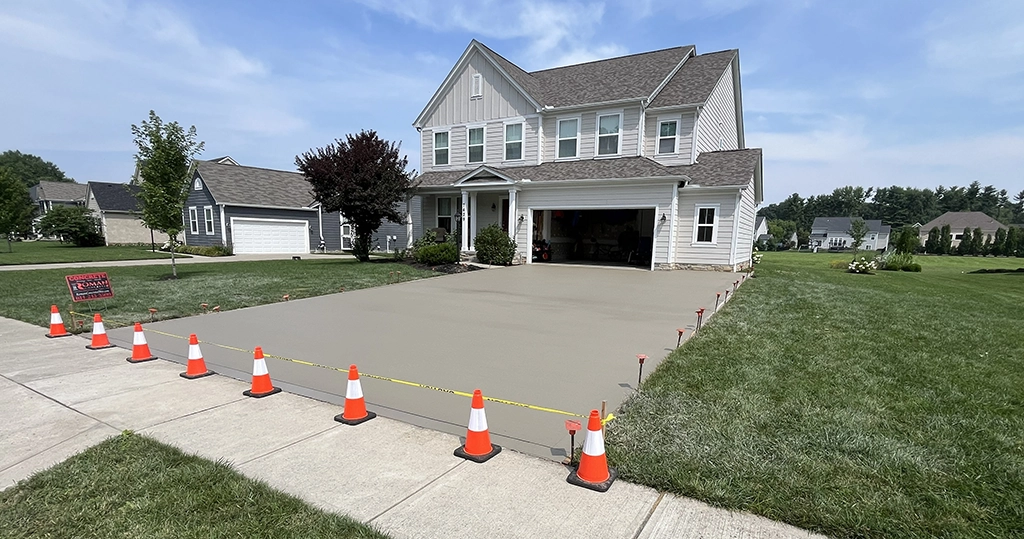
Pour day can look like controlled chaos to anyone who hasn’t seen it before: trucks lined up, a crew moving with purpose, and concrete disappearing into forms faster than you’d expect. But nothing about the concrete pouring process is improvised. Every step, from the morning walkthrough to the final sweep of the driveway, follows a sequence that’s been refined over thousands of jobs.
If you’re getting ready for a new driveway, patio, or slab, here’s what actually happens on the day the trucks arrive, and in the days that follow.
Before Concrete Pouring Starts: Planning and Preparation
Before any work begins, the experienced crew at Roman Concrete reviews the scope, design, and timeline with you one more time to make sure everything lines up with what was discussed at the original quote. From there, the site gets prepped, which includes:
- Protecting your yard. Plywood or travel mats go down anywhere equipment needs to cross the property, and if a new travel route can avoid your landscaping altogether, that route gets used instead.
- Marking the work zone. Safety cones and caution tape go up so neighbors and pedestrians know to steer clear.
- Guarding nearby surfaces. If concrete is being poured or demoed close to the house, barriers or plastic sheeting go up to catch splatter, and garage doors are opened so chipping debris doesn’t ding the metal.
- Staying road-ready. Trucks, gravel drops, and heavy equipment stay on the street whenever possible, and a hose is connected on-site so cleanup water is available the second it’s needed.
Once the forms are set, you’ll get a walkthrough to confirm the layout, heights, and locations before anyone gives the go-ahead to place concrete.
How the Concrete Pouring Process Works
This is the part most homeowners actually want to see, and it moves faster than people expect.
Getting Concrete from Our Truck to Your Property
How concrete travels from the truck to its final resting place depends on what’s already on the property. On a new build with no landscaping or driveway approach to protect, trucks can pull up and pour directly. But on an occupied home with sod and landscaping in place, trucks stay on the road while concrete is carried in on tracked buggies, running over plywood paths to keep the yard intact.
What the Crew Is Doing While It Pours
Every person on-site has a specific role before the truck even arrives. Once pouring starts, here’s what each crew member is responsible for handling:
- One crew member operates the buggy, placing concrete exactly where it’s needed.
- One crew member follows behind, straight-edging and leveling as they go.
- Two to three crew members rake and shovel it into position while watching for splatter or access issues.
No two pours behave exactly the same way. Weather, shade, mix consistency, and timing all shift slightly from job to job, which is why experience matters more in this trade than almost any other step of the concrete pouring process. A driveway that’s half-shaded, for example, gets planned differently from the first shovel, not just at finishing time.
Concrete Driveways vs. Patios: How Installation Differs
Not every pour is built the same way. Driveways and patios each come with their own grading logic and finishing priorities.
What Happens During the Concrete Driveway Installation Process?
Driveway grading is largely dictated by what’s already there. Slope needs to connect garage height to road height, with enough pitch to move water toward the street or gutter. Because this involves matching existing structures, there’s less flexibility here than with a standalone patio.
A properly loosened gravel sub-base plays a major role in how long a driveway holds up. Some contractors compact the base tightly, assuming it makes the slab last longer. In practice, it does the opposite. Concrete is rigid and the soil underneath it moves constantly—even if only by fractions of a millimeter.
A loose gravel base gives that movement somewhere to go, along with proper drainage, instead of forcing the slab above it to crack under pressure it can’t absorb. Getting this step right is one of the most important parts of the concrete driveway installation process, since everything poured on top of it depends on what’s happening underneath.
How is the Concrete Patio Installation Process Different?
Patios follow a different target: roughly 2% slope, or about ¼” per foot, angled away from the house. Because exterior concrete gets a broom finish and that texture is naturally coarser, a bit of extra slope helps water keep moving instead of pooling.
Current yard grade still factors into the plan, but drainage always takes priority. If a new patio needs to sit more than a few inches above the surrounding yard to drain properly, that gets flagged in the original scope so there are no surprises about additional yard work later. Getting the slope right during the concrete patio installation process is what determines whether water drains away from the home properly, which is why it’s addressed in the scope before the pour ever begins.
How Long Does it Take to Pour Concrete?
Timing depends heavily on the finish. Broom finishes move quickest since the texture is applied early. Stamped and exposed aggregate finishes take longer because more detailed work happens while the concrete is still workable. Here’s a quick visual breakdown of the typical timeline:
Project Type |
Typical Pour-to-Finish Time |
|---|---|
| Exterior broom finish | 2-4 hours |
| Stamped or exposed aggregate | 3-6 hours |
| Interior trowel-finished slab | 6-10 hours |
If weather shifts or a mix arrives off-spec mid-pour, the crew adjusts on the spot. Recognizing early warning signs before they become real problems is something that only comes from having handled it before, which is part of why an experienced crew matters even more than a fast quote.
What Happens After the Concrete is Placed
The work doesn’t end when the last section is leveled. Here’s what happens next:
- Day One: Forms get stripped where possible, tools get cleaned, and the crew walks the property checking for stray nails, screws, or gravel in the yard. Roads get swept, trucks get loaded, and caution tape goes back up around the fresh concrete for its first 24 hours of curing.
- Day Two: The crew returns for a shorter visit—often just an hour or two, and you don’t need to be present unless you’d like to be. This visit covers a final cleanup pass, remaining form removal, and cutting control joints in strategic locations. Caution tape and barriers come down once that’s finished.
- Sealing: A clear, solvent-based cure-and-seal membrane is sprayed on the same day the concrete is poured and finished, not on a separate visit.
Timeline for Using Your New Concrete
Once the crew wraps up, the countdown to actually using your new concrete begins. Here’s how long to wait before walking on it, moving furniture back, or pulling a car into the driveway:
Milestone |
Wait Time |
|---|---|
| Walking | 24 hours |
| No furniture movement | 24 hours |
| Moving furniture back | 7 days |
| Driving or parking | 7 days |
The most common issue during this window isn’t cracking or damage—it’s staining, usually from mulch or soil left sitting on fresh concrete, or from a car with an oil leak parking too soon. Both are easy to avoid with a little patience.
How Does the Concrete Pouring Crew Handle Cleanup?
Cleanup gets treated with the same care as the pour itself. Grass and soil that get disturbed by foot traffic during the job typically bounce back within two to five days. If something gets missed, whether that’s a stray nail or a spot of debris, letting the crew know brings them back out for another pass.
Every completed project is backed by a 12-month warranty, timed intentionally to cover a full cycle of Ohio’s seasonal swings. Materials and methods are chosen specifically to hold up through that stretch, so making it through all four seasons without surface or structural issues is a genuine sign the job was done right.
Ready to See the Process in Person?
If you’re planning a new driveway, patio, or slab and want to know exactly what your pour day will look like before it happens, we’re happy to walk you through the process in detail. We’ll cover the site prep, the timeline, and what to expect during the pour itself, so there are no surprises once the trucks show up.
Get in touch today to schedule your free estimate, or call us at (614) 245-3500.